
Survey to scope
Quantities, materials and areas are taken from the report you were sent. Anything the report cannot tell you becomes a question for you rather than an assumption.
The containment and the removal are work your crew already does well. The margin is lost on the office side: a notification filed late, a refresher certificate that expired mid-job, and a closeout binder the general contractor wants before he releases retainage. Timber reads the hazmat survey, prices the scope against your own rate book, tracks certification dates, and assembles the closeout package as the documents arrive.
10-day notification
4 days
Drafted from the survey. Awaiting supervisor signature.
L. Ortega
Supervisor
D. Whitfield
Worker
M. Sowah
Worker
Closeout package

10-day
Notifications are drafted from the survey you uploaded rather than retyped by hand
Certs
Refresher and fit-test dates are checked before you assign anyone to a containment
Closeout
The binder fills up while the job runs instead of being assembled afterwards
Abatement contractors rarely lose money on the removal itself. They lose it on the documentation that has to exist before an owner, an inspector or a general contractor will accept the work as finished.
The hazmat survey already lists the homogeneous areas, the material types and the quantities. Someone in the office still copies all of it into the state notification form by hand, and amends that form again every time the start date moves.
Accreditation, the annual refresher, medical surveillance and the fit test all expire on their own dates. One lapsed card on site means a stop-work order and a fine, and those dates usually live in a spreadsheet nobody has opened this month.
Pressure readings, HEPA runtime, decontamination entries and who was inside the enclosure are recorded on a clipboard. When an inspector asks for last Tuesday's readings, somebody has to go and find the sheet.
The owner wants waste manifests with the landfill signature returned, clearance results, sign-in sheets and disposal records. The removal finished in April, but payment arrives whenever the binder is finally complete.
Upload the hazmat survey or inspection report. Timber pulls out the homogeneous areas, material types and quantities that the report states, then asks you about the things a survey never covers: building access, whether the space is occupied, which shift you will work, negative air requirements and the disposal site.

Timber prices containment, negative air, labor by the crew-day, encapsulant, disposal at your own tipping rate and third-party clearance. Mobilization and per-diem appear as their own lines instead of being buried inside the labor figure.
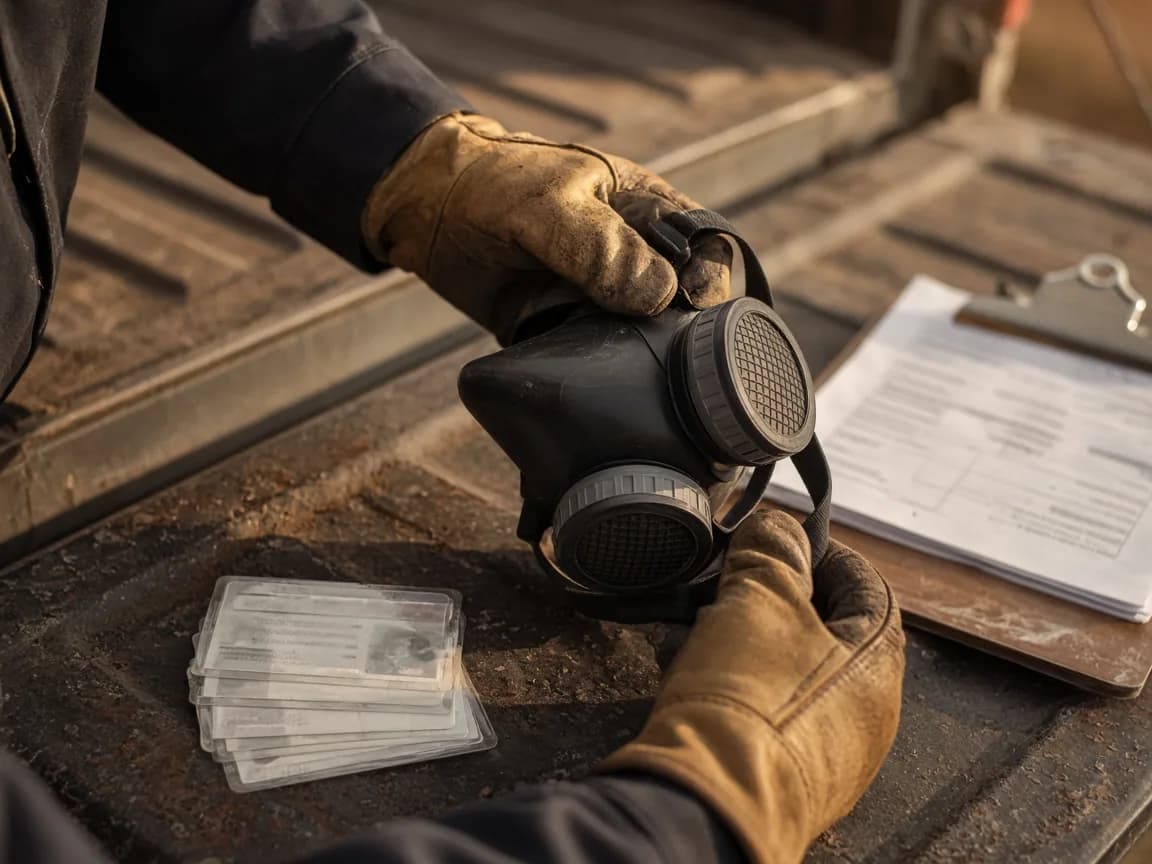
The notification is drafted from the scope you have just priced. Certification dates are checked against the crew you assigned. Daily logs arrive by text message from the foreman. The closeout package fills up as each document lands.

The same software handles a single-room lead job and a full-floor asbestos strip-out running on night shift.
Timber does not sign your notification and it does not clear your containment. What it removes is the several hours of retyping between the survey arriving in your inbox and a defensible number going back to the general contractor.
Stays with you
Timber drafts the notification and tells you when the deadline falls. A licensed person on your staff reviews it and submits it. We will not put your license behind a filing that happens on its own.
Stays with you
A third-party hygienist clears the area. Timber tracks the sample, chases the result and files it on the job. It does not produce a clearance itself.
Stays with you
Timber tells you whose certification expires on Friday. You still decide who works, and an assignment made in error can be rolled back.
Quantities, materials and areas are taken from the report you were sent. Anything the report cannot tell you becomes a question for you rather than an assumption.
Accreditation, refresher dates, medical surveillance and fit tests are stored against each worker. Timber flags a lapse before you put that name on a containment.
The scope you priced becomes the notification draft, including the amendment when a start date moves. You review it and file it.
Pressure readings, HEPA hours, headcount and photos arrive by SMS or WhatsApp. There is no app to install for a crew that changes between seasons.
Manifests, clearance results, sign-in sheets and daily logs collect under the job as they arrive, so the package already exists when the owner asks for it.
Crew-days, disposal weight and equipment rental are compared against the bid, so you can see which scopes you underpriced while there is still time to price the next one differently.
Abatement is one of the few trades where doing the work well is not enough to get paid. The scrape, the bag and the wipe are the straightforward part. Getting paid also requires a notification filed on time, a crew whose certifications were all current on the day they entered, waste that can be traced to a landfill signature, and an air clearance from a third party who does not work for you.
Most abatement contractors run all of that on a shared drive, a whiteboard and one person who knows where everything is. That works until the person is on vacation and a start date moves, or until an inspector walks the job and asks for last Tuesday's pressure log.
Timber sits between the survey and the binder. It reads the report you were sent, prices the scope against your rate book, drafts the paperwork that the scope implies, and keeps every log and manifest attached to the job that produced it. Your supervisor still signs, your hygienist still clears the area, and nothing is filed in your name without you.
Send a real hazmat survey along with the scope you would have priced from it. We will show you what Timber pulls out of the document and what it asks you about. If it cannot read your reports, we will tell you that rather than sell you a trial.
Or write ivan@felicita.group
Still deciding? Book a demo and we will go through your own workflow live — your documents, your rates, your schedule.
No. It drafts them from the scope you priced, tells you when the deadline falls, and drafts the amendment when a date changes. A licensed person on your staff reviews and submits the filing.
Other work Timber runs
Send in a survey and get back a priced scope and a compliance record, without adding another coordinator to payroll.
No credit card to start. Cancel any time.